


Editorial: The Right to Vote Is a Sacrifice We Must Never Take for Granted

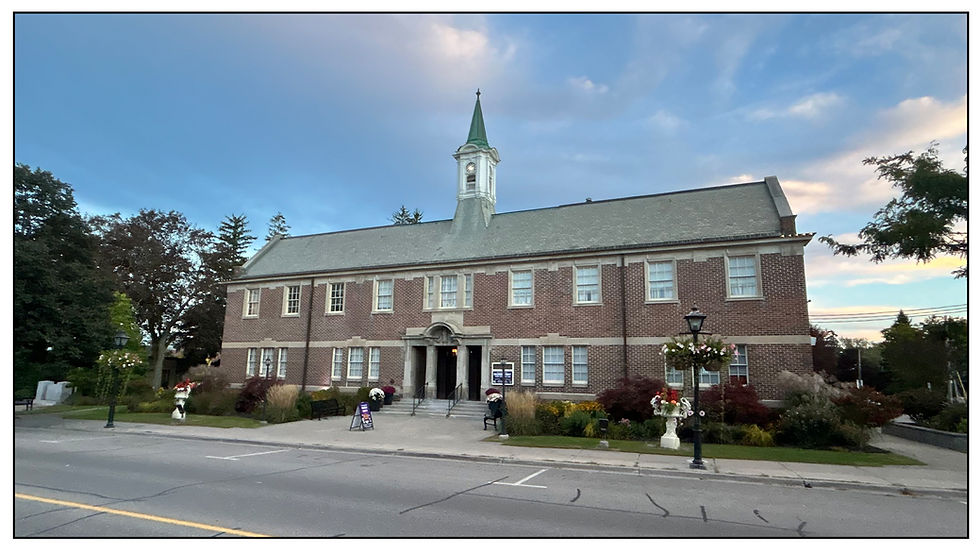
Over the past two months, I have had the pleasure of returning to Newcastle, and reconnecting with the surrounding communities that have helped shape my understanding of what it means to belong somewhere. From Kendal and Orono to Port Granby, Bond Head and Newtonville, my travels have reminded me that a community is much more than a collection of streets, homes and businesses. It is a living history, built by generations of people who have invested their time, their energy and, in some cases, their lives in the place they call home.
On my first visit back in September, I along with my Mother and Father stopped at the Newcastle Community Hall, to visit the Newcastle Historical Society. As I entered the building, I noticed the same names of veterans displayed on the walls that I had passed many times before. This time though, I paused to take them in, something I haven’t done in year.
Those names represent people who served our country during some of its darkest hours. They represent men and women who left their families, their homes and the communities they loved to defend something greater than themselves. Some returned home. Others made the ultimate sacrifice and never had the opportunity to see the country they helped preserve continue to grow and change.
Standing there, I could not help but think about the upcoming municipal election on October 26. I thought about the candidates preparing to make their case to voters, the residents who would attend public debates, and the people who would eventually mark their ballots to determine the future direction of their municipality.
And I wondered whether we fully appreciate what it took to secure that right.
The freedom to vote, to disagree openly, to challenge our elected representatives and to gather in a school gymnasium to debate the future of our community did not simply appear one day. These freedoms have been defended, protected and preserved through generations of sacrifice. They are among the foundations of our democracy, and yet, in the comfort of our everyday lives, we can sometimes forget just how precious they are.
On October 8, the Orono Weekly Times and my Municipal Affairs Program, Cross Border Network partnered together to host a debate featuring candidates in the 2026 Clarington municipal election, including those seeking to represent Ward 4 and Regional Ward 3 and 4, and Mayor at Pines Senior Public School. It was an opportunity for residents to hear different perspectives, consider competing priorities and decide which candidates best reflected their hopes for the community.
These events do matter. They give voters the chance to look beyond campaign signs, social media posts and carefully worded promises. They allow candidates to explain their positions, respond to questions and demonstrate how they might lead. Most importantly, they give residents a place to participate in the democratic process together.
But as I sat in that gymnasium, trying to internally drown out the sounds of dodgeballs hitting my head from grade 8, and my horrible acting performance in the grade 7 school play, I listening to the discussion and looking around the room, one question kept returning to me.
Where is the next generation of municipal leaders? Where are the next generation of voters? And where are the next generation of volunteers who will help keep our communities strong?
These are not questions intended to criticize young people. Nor are they meant to suggest that younger generations do not care about their communities. Many do, and they are contributing in meaningful ways through their work, their advocacy, their volunteer activities and their efforts to make the world a better place.
Rather, these are questions we must ask ourselves as a community. If we want younger people to participate in municipal politics, we must make room for them. If we want them to vote, we must help them understand why their votes matter. And if we want them to become the next generation of community leaders, we must show them that public service is not reserved for a select few.
It begins with engagement. It begins with showing up.
As I looked around, I recognized faces I remembered from my own experience running in the 2010 municipal election in Ward 4. Sixteen years have passed since that campaign, but there were people in that room who seemed as familiar as ever.
I saw my former dentist, Rod McArthur saw former local councillor and accomplished auctioneer Frank Stapleton, sitting near the front alongside his wife, Betty. There was former Member of Parliament and Minister the Hon. Bev Oda, and I saw residents whose commitment to this community has endured through changing times, changing priorities and changing municipal councils.
Their presence was a reminder of something both reassuring and troubling.
It was reassuring because communities need people who remain involved. We need residents who continue to attend meetings, ask questions, volunteer their time and hold elected officials accountable. These are the people who understand that building a community is not a one-time project. It requires sustained effort, patience and a willingness to keep participating, even when the results are not immediately visible.
But it was troubling because I found myself wondering who would eventually take their place.
What happens when the people who have attended municipal debates for decades can no longer make the trip? Who will sit in the front rows of school gymnasium? Who will organize community events, serve on local boards, volunteer at fundraisers and encourage elected officials to remember the people they represent?
Every generation eventually passes the responsibility to the next. The question is whether we are preparing the next generation to accept it.
Municipal politics may not always capture the attention of national headlines, but its decisions have an immediate and lasting impact on our daily lives. Decisions made at the municipal level influence roads, recreation facilities, parks, libraries, development, public services and the character of our neighbourhoods. They help determine what our communities will look like not only next year, but decades from now.
When we elect a municipal council, we are entrusting people with the responsibility of helping guide our community for the next four years. Those decisions affect young families buying their first homes, seniors hoping to remain in their neighbourhoods, businesses investing locally and young people deciding whether their hometown offers them a future.
That is why municipal elections deserve our attention.
I will never discourage anyone from voting, and I will never tell someone which candidate they should support. That is not my responsibility. The decision belongs to each individual voter, informed by their own experiences, priorities and judgment.
My responsibility, as a citizen who cares deeply about communities of all sizes in all provinces and territories, is to encourage people to participate in the process.
We do not have to agree on every issue to share a commitment to democracy. In fact, democracy depends on our ability to disagree without losing respect for one another. At a candidate debate, one person may prioritize responsible spending, another may focus on development, and someone else may be concerned about roads, recreation or the preservation of small-town character. Those differences are not a weakness. They are part of what makes democratic debate valuable.
The objective is not to eliminate disagreement. It is to create a space where disagreement can be expressed peacefully, where ideas can be challenged and where voters can make informed decisions.
My husband, who was born and raised in Nicaragua, often reminds me that democratic freedoms should never be taken for granted. His experiences and perspective have helped me appreciate how fortunate we are to live in a country where we can gather publicly, criticize our political leaders and participate in elections.
Recent political developments in Nicaragua have made those conversations particularly sobering. The country's political environment has been marked by severe restrictions on political opposition and democratic participation. The broader lesson is that democratic institutions cannot be assumed to protect themselves. They require citizens who value them and are prepared to defend them.
Canada is not immune to democratic challenges, and our democracy is not strengthened simply because we have elections on a calendar. It is strengthened when people participate meaningfully, when elected officials are held accountable, and when citizens understand that their voices have a place in shaping public policy.
We should be grateful that we can sit in a school auditorium for three hours, listen to candidates disagree and walk out knowing that we have the freedom to choose our representatives. We must turn that appreciation into action.
That action does not have to be complicated.
It can mean taking a first-time voter to a candidate debate. It can mean explaining to a teenager why the decisions made at town hall affect their future. It can mean inviting a younger neighbour to join a community association or encouraging a young professional to consider serving on a municipal committee.
It can mean asking our children and grandchildren what they would change about their community, then listening carefully to the answers.
And, perhaps most importantly, it means demonstrating through our own actions that participation matters.
Over the years, I have attended political events, municipal conventions in every province and two of the three territories speaking with municipal leaders of all sized communities. In those convention rooms, I have begun to notice younger faces appearing more frequently. That is encouraging. It suggests that the next generation is beginning to find its place in public life.
But we need more of them.
We need younger voters to recognize that municipal elections are not just about the people whose names appear on lawn signs. They are about the places where those voters will raise their families, build their careers, establish businesses and grow old. We need younger volunteers to understand that the health of a community depends on people willing to contribute something beyond their own immediate interests. And we need future leaders to recognize that public service can be a meaningful way to make a difference.
At the same time, those of us who have been involved for years must be willing to welcome new voices. We cannot complain about the absence of younger leaders while making it difficult for them to participate. We cannot insist that things must always be done the way they have been done before and then wonder why younger people do not feel represented.
If we want them at the table, we must make room.
As October 26 approaches, I find myself thinking again about those names on the wall at Newcastle Community Hall. I think about the men and women who served during the First World War, the Second World War, the Korean War and the Afghanistan War, among other chapters of Canada's military history. Their experiences were different, their circumstances were different, and their reasons for serving were personal. Yet their service forms part of the history that allows Canadians today to exercise democratic freedoms.
We cannot know what any individual veteran would think about the state of our politics today. But we can recognize the responsibility that comes with inheriting the freedoms previous generations worked to preserve.
Perhaps that is the question we should all be asking ourselves as we prepare to vote: Are we doing enough with the opportunities we have been given?
Are we encouraging our neighbours to participate? Are we teaching our children that democracy requires more than complaints made around the dinner table? Are we supporting the volunteers who keep our communities running? Are we preparing younger Canadians to become the councillors, organizers, advocates and voters who will carry this responsibility forward?
I hope the answer will increasingly be yes. I hope residents will exercise their right to vote. I hope they will take the time to learn about the candidates, consider the issues and make a decision that reflects their vision for the community. And I hope that, among those heading to the polls, there will be more young people who see themselves not merely as residents of Clarington, but as active participants in its future.
And I hope that, when the next generation of voters, volunteers and municipal leaders finally takes its place, the names on those walls will stand as a reminder of what previous generations sacrificed—and why we must never stop doing our part.
Because the question is not simply who will lead us after October 26.
The question is whether we are preparing a generation willing to step forward when its turn comes.
That is a responsibility we all share. And it is one we cannot afford to leave to someone else.




Comments